Pearson Edexcel · GCSE · English Language
Course version: 1EN0 · Version from Mar 2026
AO7: Demonstrate presentation skills in a formal setting
Full specification wording
Assessment Objectives: AO7: Demonstrate presentation skills in a formal setting
AO7 requires you to plan and deliver a spoken presentation to an audience in a formal setting, such as a classroom or hall.
Checked against the Pearson Edexcel 1EN0 specification (opens in a new tab) on .
- Point 7 of 9
- 4 key terms
Study notes
From the checked teaching notes for this specification point.
The idea
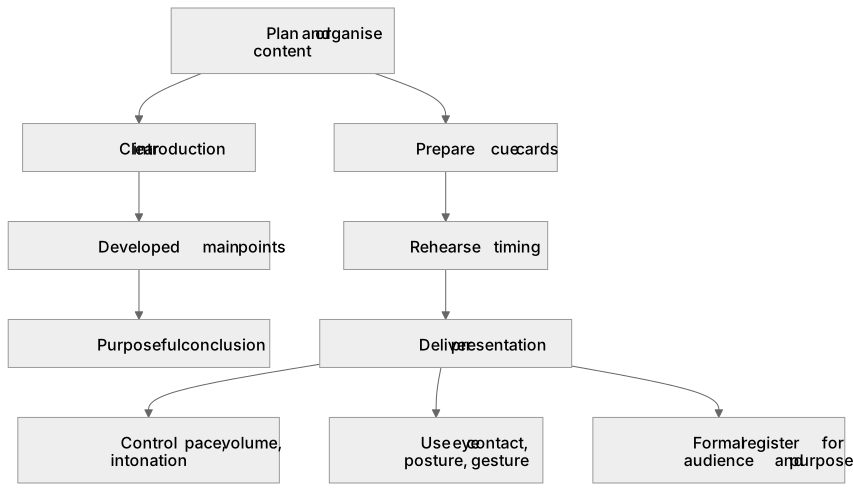
AO7 requires you to plan and deliver a spoken presentation to an audience in a formal setting, such as a classroom or hall. You must select and organise content clearly and control tone, pace, volume and body language so your message is understood. For example, a presentation on reducing plastic waste might open with a striking fact, explain three practical actions, and close with a direct appeal. Prepare cue cards, rehearse timing, and make deliberate eye contact. Assessment focuses on how effectively you communicate meaning through spoken language, not on written notes alone. Your teacher observes your live or recorded presentation and judges your overall performance against the assessment objective. Keep AO7 distinct from AO8, which covers listening and responding to questions and feedback, and from AO9, which assesses spoken Standard English.
What earns the marks
- Selecting and organising content so that the presentation has a clear introduction, developed main points and a purposeful conclusion.
- Controlling delivery features such as pace, pause, volume, intonation and pronunciation so meaning is clear and engaging.
- Using non-verbal communication, including eye contact, posture, gesture and facial expression, to support the spoken message.
- Adapting language and content to the audience and purpose, for example by explaining technical terms or using rhetorical questions.
- Maintaining audience engagement through direct address, rhetorical devices and a confident, audible delivery.
- Sustaining a formal register appropriate to the setting, distinguishing presentation skills from the separate assessment of spoken Standard English under AO9.
Common mistakes and how to put them right
Reading word-for-word from a script.
Put it right: Use brief cue cards with keywords and rehearse so you can speak naturally.
Speaking too quickly or quietly because of nerves.
Put it right: Practise with a timer and record yourself, then adjust pace and volume deliberately.
Including too much detail without a clear structure.
Put it right: Plan three or four main points and signpost each one with phrases such as 'First' and 'Finally'.
Treating AO7 as a test of spoken Standard English.
Put it right: Focus AO7 preparation on organising and delivering the presentation effectively in a formal setting.
Confusing AO7 with AO8 by planning to answer audience questions as part of the presentation.
Put it right: Prepare the presentation itself for AO7, and treat question-and-answer as separate AO8 practice.
Exam tips
- Rehearse aloud with a timer and, if possible, record yourself to check audibility, pace and clarity.
- Prepare cue cards with short bullet points rather than full sentences so you can maintain eye contact.
- Open with a hook such as a question or statistic, signpost your main points, and end with a clear closing statement.
Try the lesson
The start of the Assessment Objectives: AO7: Demonstrate presentation skills in a formal setting lesson, made from checked teaching notes for this specification point.
Have a go first
Which of these is the most effective presentation skill to use when delivering a speech in a formal setting?
Listen
AO7 requires you to plan and deliver a spoken presentation to an audience in a formal setting, such as a classroom or hall. You must select and organise content clearly and control tone, pace, volume and body language so your message is understood. For example, a presentation on reducing plastic waste might open with a striking fact, explain three practical actions, and close with a direct appeal. Prepare cue cards, rehearse timing, and make deliberate eye contact. Assessment focuses on how effectively you communicate meaning through spoken language, not on written notes alone. Your teacher observes your live or recorded presentation and judges your overall performance against the assessment objective. Keep AO7 distinct from AO8, which covers listening and responding to questions and feedback, and from AO9, which assesses spoken Standard English. A strong answer earns marks for these points. Selecting and organising content so that the presentation has a clear introduction, developed main points and a purposeful conclusion. Controlling delivery features such as pace, pause, volume, intonation and pronunciation so meaning is clear and engaging. Using non-verbal communication, including eye contact, posture, gesture and facial expression, to support the spoken message. Adapting language and content to the audience and purpose, for example by explaining technical terms or using rhetorical questions. A common slip: Reading word-for-word from a script: this weakens eye contact and vocal variety. Instead, use brief cue cards with keywords and rehearse so you can speak naturally. Exam tip: Rehearse aloud with a timer and, if possible, record yourself to check audibility, pace and clarity.
See it
Key words
Say what each word means before you turn the card.
Formal spoken register
Try answering aloud or in your head before turning the card.
Audience awareness
Try answering aloud or in your head before turning the card.
Structure and cohesion
Try answering aloud or in your head before turning the card.
Vocal and non-verbal delivery
Try answering aloud or in your head before turning the card.
See every definition
- Formal spoken register
- A way of speaking appropriate to a formal setting, such as a classroom or hall, sustained throughout the presentation.
- Audience awareness
- Adapting language and content to the audience and purpose, for example by explaining technical terms or using rhetorical questions.
- Structure and cohesion
- Selecting and organising content so that the presentation has a clear introduction, developed main points and a purposeful conclusion.
- Vocal and non-verbal delivery
- Controlling pace, pause, volume, intonation and pronunciation, and using eye contact, posture, gesture and facial expression, so meaning is clear.
Label the diagram
Some boxes have lost their names. Pick the right name for each number.
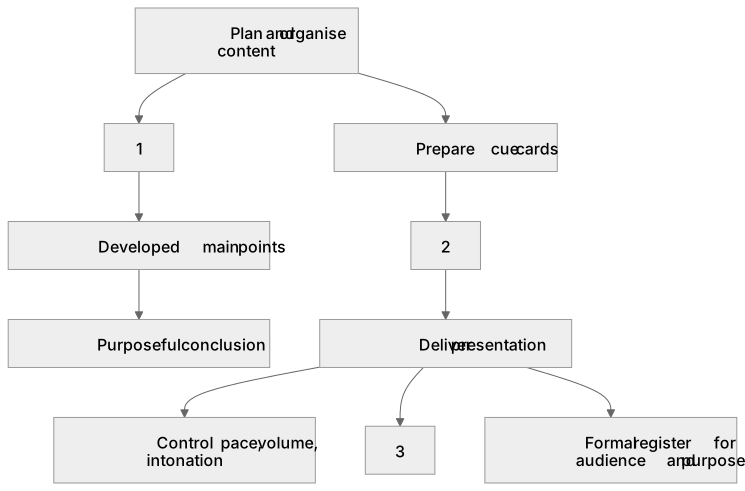
1Box 1
2Box 2
3Box 3
There is more to this lesson
The full lesson goes on to check your understanding and help you earn the marks. Create a free account to carry on, with your progress saved.
A week of Premium from your first lesson · Then the free plan continues · No card, no charge
Test your understanding of Assessment Objectives: AO7: Demonstrate presentation skills in a formal setting
Active recall beats re-reading. Take an instant quiz now to test what you’ve learned and lock it into long-term memory.
A week of Premium from your first lesson · Then the free plan continues · No card, no charge